http://issuu.com/gamaliel_wb/d
The Crane Song by Iwan Effendi
The picture you see above is what inspired me to have a closer look at this artist and his work and made me want to find out more about what exactly was going on in this artwork. Iwan said this about Crane Song “it is a diptych of opposing colours of blue and orange tones composed of a man who wears eyes as his cloak”

Iwan Effendi
Maybe we need to look back at history to see where Ivan’s imagery is coming from. Here is an entry from an article written by Marilyn Goh.
In 1965, Indonesia found itself once again at a political crossroads after having endured an extended period of political instability since securing independence from Dutch colonial rule. In the twilight of President Sukarno’s rule in 1965 marked by bitter ideological conflict and political polarization, a coup at the end of September triggered a widespread wave of violence that brought General Suharto to office for over 3 decades. Generations removed from these events after 5 decades, the suppression of dissident artistic voices in the Suharto’s iron-fisted rule mean that contemporary Indonesian artists have only in recent years, begun their cathartic response to the trauma.
Eye of the Messenger by Iwan Effendi
This artwork is a response to the turmoil: interrogating the construction of Indonesian history in political upheaval of the 1960s and ultimately acknowledges that the socio-cultural and political discourses surrounding these years are cultivated, cultured and fabricated.
The works in Eye of the Messenger are ironic and multi-layered: dismembered, colourful body parts float in the dimensional space of the canvasses and are tacked onto each other. They can’t be contained by the boundaries of canvas, spilling out of the seams and onto the surrounding white walls. Unlike the luminous simplicity and crack-quality of flat-faced satiric drawings that invite ridicule and laughter, Effendi’s cartoonish works cry out like multiple voices in a Greek tragedy clamouring to claim their own truth. In this context of use, reception and exchange, Effendi’s works accrue a varied interpretive history of – and perhaps even grant absolution to –those who have found finally regained their silenced voices.
“Long Lost Memories” by Iwan Effendi
Iwan describes “Long Lost Memories” as a piece of bulbous objects, bird eggs and birds that peer disconcertingly into nothingness. “But thank god, our eyes can’t lie,” Effendi further remarks. Ocularity and perception feature prominently in his canvases; the physical eye, and by extension, the visual experience, is used as a cautionary metaphor because of its ability to fall prey to yet simultaneously, resist manipulations.
Imaginative characters placed amidst the bright colors of a never-never land is the visual language of Iwan Effendi. Ofttimes we come across war-like visual elements in his works; aircraft, tank, which occasionally deformed in animal shapes. It allied closely to his fondness for war stories, such as the epic of the Second World War. It was into this tale that Iwan unravelled his ideas.
Iwan Efendi’s imagery also became characters in the form of puppets. His grandfather had been a puppeteer artist who devoted himself to the tradition of wayang. in He heard the story about the arrest of his grandfather, a puppeteer artist who devoted himself to the tradition of wayang. He, as well, understood that his grandfather was arrested for being alleged as a member of Communist Party of Indonesia (Partai Komunis Indonesia, PKI).

Iwan's Puppet Show
 Puppet Performance in the opening of Iwan Effendi solo show at Yavuz Fine Art
The opportunity to meet Maria Tri Sulistyani, a children’s book author who later became his beloved wife, has led him to visualizations of children’s tales from around the world. He did not stop there; he developed Papermoon puppet theatre, which was formerly initiated by Maria. Together with his wife, Iwan began exploring the medium of puppets. To Iwan Effendi, the expansion of his visual expressions into puppet theatre is an extraordinary challenge that would meet no end. Accepting and referring to the philosophy of puppet theatre—“sincerity of being nobody”—Iwan put aside his ego as an artist and surrender himself to the world of puppeteering. It had not been an easy start, yet lately he found it intensely addictive; puppet theatre has animated his visual figures. extract from an article written by Ade Tanesia
Sources: Ade Tanesia and Marilyn Goh

The “Missing” Eye of the Messenger
Astrid Reza
Let us imagine Indonesia in 1965 as a 20-year-old nation. A dynamic, intelligent, vigorous youth. Brave enough to refused the aid from United States. Believed in being revolutionaries to change the nation faith for the better. The political dynamic was in its heyday, with the Indonesian Communist Party (PKI – PartaiKomunis Indonesia) seems to be winning the majority. Then suddenly after the night of 30th September 1965, this youth changed dramatically. The eye of the youth changed into a dark gloomy desperate old eye. The youth body lost its spirit, oppressed and just stood there as to watched the bloodiest event in the modern Indonesian history. Millions were killed and gone missing, no one know the exact number. The effect of the event was tremendous that the rivers in Java and Bali turn to the color of blood red.The army took power under General Suharto. No one stop the killings under the name to exterminate the communist. Since then the word “communist” went missing from the tongue of Indonesian cause of fear and traumatized memories. It was an unstoppable mass killing unheard by the world maybe even until today.
Forty-six years later, we found this same eye lingering still in Iwan Effendi’s paintings. At sixty-six years old, Indonesia became the fat old corrupted image of an old man. But the eyes, the same dark gloomy desperate old eye stayed the same. It stayed as to wait for judgment day. Some say, the eyes are the key of the heart. These eyes represent the Indonesian heart struggling with their unresolved histories.
In the series of paintings by Iwan Effendi together with the poems of Maria Tri Sulistyani, this “missing” histories making their way to be re-interpreted by the generations of Indonesian who are lost in the knowledge of their own history. For to understand ourselves today is to dig into our own history, on where we come from and how are we standing here today. Iwan uses the metaphor of eyes, heads and birds throughout his paintings to describe his perception of the event in 1965. The lost of hope in the sad eyes, decapitated heads everywhere and rumors around the event (“kabarburung” in Indonesian means “news bird” or to be translated as gossip surrounding the truth). While Maria’s poem seems to sing away in a melancholic tone accompanying the paintings. If Iwan’s painting could sing, Maria’s poems are their voices.
While working on his works, no matter how bright the colors Iwan’s trying to put in his painting, the gloom of the work atmosphere always stays. The process for him is like taking off a dark veil of his own nation. Like what Maria said because this matter could not be taken lightly that it’s not a bright happy thing to be brought up. To talk about the killings, the sadness, the anger, the silence and the lost of hope from such a long time, had never been an easy thing to do for anyone. To express the poems for her is to mourn the faith of the unheard victims.
These works are an attempt to reread the history of a nation, of what had gone wrong, putting a puzzle together to convey a message from the past for a better humanity in the future. It is a reminder for us that the same thing could happen again. Humancapability of destruction and violence could create such a hellish moment in a nation’s memories. Finding the truth of the event is very important as a learning process for every single human being. For the hope someday the eye of the messenger could flicker and brighten. That an old body could maintains its young spirit and optimistic heart. That hope could never be completely lost.
Yogyakarta, 10th September 2011

Iwan Effendi, The Crane Song, 2011, Acrylic on canvas, 100cm x 150cm. Image Courtesy of Yavuz Fine Art.
The joy and plight of many contemporary, Western-centric cultural practices today is the recognition that artistic shouldering of the collective burden of history does not necessarily attribute any value to the work. At worst, it is unfashionable and counter-productive to contemporary discourse; at best, it provides a vague notion of plurality and diversity that benefits a particular portion of the arts patronage. On the contrary, contemporary Asian art’s transformative power and value in the region, almost always lies in recollection of the memories of post-war political independence, the marvel at socio-economic progress and sorrows of rapid industrialization.
In 1965, Indonesia found itself once again at a political crossroads after having endured an extended period of political instability since securing independence from Dutch colonial rule. In the twilight of President Sukarno’s rule in 1965 marked by bitter ideological conflict and political polarization, a coup at the end of September triggered a widespread wave of violence that brought General Suharto to office for over 3 decades. Generations removed from these events after 5 decades, the suppression of dissident artistic voices in the Suharto’s iron-fisted rule mean that contemporary Indonesian artists have only in recent years, begun their cathartic response to the trauma.
Eye of the Messenger by Iwan Effendi at the Yavuz Fine Art Gallery is such a response, interrogating the construction of Indonesian history in political upheaval of the 1960s and ultimately acknowledges that the socio-cultural and political discourses surrounding these years are cultivated, cultured and fabricated.
As Walter Benjamin wrote, the craft of storytelling, does not aim to convey the pure essence of the thing, like information or a report, [but instead] sinks the thing into the life of the storyteller, in order to bring it out of him again. Similarly, a desire to contribute his own gesture of political resistance and social commentary underlies Effendi’s surrealistic images through a combination of word-and-image binary that is part-storytelling, part-myth and part-reality.

Iwan Effendi, Long Lost Memories, 2011, Acrylic on canvas, 70.5cm x 150cm. Image Courtesy of Yavuz Fine Art.

Iwan Effendi, The Bird Who Feeds The Fish, 2011, Acrylic on canvas, 70.5cm x 150cm. Image Courtesy of Yavuz Fine Art.
“Here I tell you, my friends,” Effendi writes in his catalogue, “a story where history was buried.” A large green tree with all-seeing eyes dominates Treasure Hunt (2011); The Crane Song (2011) is a diptych of opposing colours of blue and orange tones composed of a man who wears eyes as his cloak; Long Lost Memories (2011) is a piece of bulbous objects, bird eggs and birds that peer disconcertingly into nothingness. “But thank god, our eyes can’t lie,” Effendi further remarks. Ocularity and perception feature prominently in his canvases; the physical eye, and by extension, the visual experience, is used as a cautionary metaphor because of its ability to fall prey to yet simultaneously, resist manipulations.

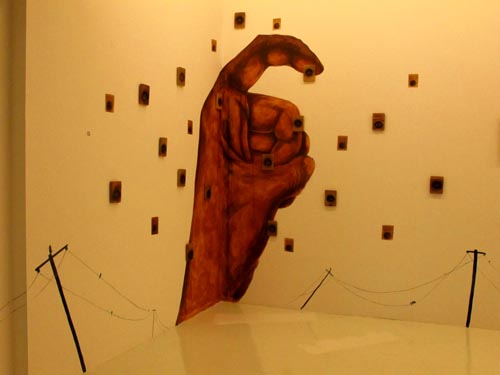
Iwan Effendi, Eye of the Messenger 2011, Installation View. Image Courtesy of Yavuz Fine Art.
The works in Eye of the Messenger are ironic and multi-layered: dismembered, colourful body parts float in the dimensional space of the canvasses and are tacked onto each other. They can’t be contained by the boundaries of canvas, spilling out of the seams and onto the surrounding white walls. Unlike the luminous simplicity and crack-quality of flat-faced satiric drawings that invite ridicule and laughter, Effendi’s cartoonish works cry out like multiple voices in a Greek tragedy clamouring to claim their own truth. In this context of use, reception and exchange, Effendi’s works accrue a varied interpretive history of – and perhaps even grant absolution to –those who have found finally regained their silenced voices.
***
Eye of the Messenger is on show at the Yavuz Fine Art Gallery until 13 November 2011.


The Victim's Silent Tale
(Solo Exhibition of Iwan Effendi feat Papermoon Puppet Theatre)
By Ade Tanesia
He heard the story about the arrest of his grandfather, a puppeteer artist who devoted himself to the tradition of wayang. He, as well, understood that his grandfather was arrested for being alledged as a member of Communist Party of Indonesia (Partai Komunis Indonesia, PKI). Only one that he did not realize, the plot behind the incident.
Had always been very close to his grandfather, yet no words on his grandfather's past to tell. "Perhaps I was his best-loved grandson. He was waiting for my birth. Among others, it was only me who had the privilege to climb up to his lap as he sat in his chair," Iwan Effendi recalled.
Such a wonderful grandfather; it is the memory Iwan Effendi have always had in mind. It was not until his participation in September Something in 2008—a visual art project organized by Kedai Kebun Forum—that his lack of curiosity about his grandfather's history had ceased.
"We were attending a workshop on the trauma of 1965 Affair. I, as a part of the generation of 2000 who was born in 1979, scarcely had knowledge of the anti-PKI massacres. I have heard of it, but I was not completely aware of what it really meant," he stated.
"September Something" art project which aim was to trace the history of 1965 from the living room has motivated Iwan Effendi to fit together the pieces of his family tale puzzle. He started compiling the stories of his grandfather from his mother's siblings, particularly from his uncle who had already reached fifteen at the time of the Affair. Many were also gained from the late mother of his; vaguely-heard ones finally began interlacing into a whole horrifying story.
"At that time, in 1965, he was summoned to the village's administrative unit's office, they said. Only the village officials who picked up my grandfather. It seemed pretty normal. However, he had never come back home again for thirteen years. Having to take care of nine children, my grandmother faced a hard time. She, eventually, decided to send them to relatives homes in different cities so that they could grow in a "healthy" environment without being accused as the children of PKI.
Stimulated by the secret tragedy kept in the memory of his family, Iwan dug into the narrative of an egregious history occurred in the year of 1965 as the blood of millions of this country's citizens was shed—the period that had ceased this country's high hopes, as expected by its founder, to become a great nation. Rapaciously, Iwan Effendi delved himself into various books and investigated historical data of 30 September Movement (G30S). He questioned himself as a visual artist "whether the past he clutches at today would or would not find its visual language".
Imaginative characters placed amidst the bright colors of a never-never land is the visual language of Iwan Effendi. Ofttimes we come across war-like visual elements in his works; aircraft, tank, which occasionally deformed in animal shapes. It allied closely to his fondness for war stories, such as the epic of the Second World War. It was into this tale that Iwan unravelled his ideas. During his former study at the Fine Arts Department of the Institute of Teaching and Educational Sciences (IKIP) Bandung, he expressed his ideas in a variety of human body movement. As he moved to Jogjakarta, pursuing his study at the Indonesian Institute of the Arts majoring in painting, his visual movement has shifted from realist to imaginative. Back then the street art genre pioneered by his seniors has influenced his art methods. The typical street art style, intersected with comical icons, was the artifacts that played an important role in the development of his artistic language.
The opportunity to meet Maria Tri Sulistyani, a children's book author who later became his beloved wife, has led him to visualizations of children's tales from around the world. He did not stop there; he developed Papermoon puppet theatre, which was formerly initiated by Maria. Together with his wife, Iwan began exploring the medium of puppets. To Iwan Effendi, the expansion of his visual expressions into puppet theatre is an extraordinary challenge that would meet no end. Accepting and referring to the philosophy of puppet theatre—"sincerity of being nobody"—Iwan put aside his ego as an artist and surrender himself to the world of puppeteering. It had not been an easy start, yet lately he found it intensely addictive; puppet theatre has animated his visual figures.
The imaginative visuals he worked on in detail is placed in the room settings which tracks would be untraceable in real world. Within this context that Iwan Effendi unfolds the stories of his life. At first, he did not emphasize his idea under just one specified theme, as in "Unhappy Family", expressing his mother's demise that also brought a touching story of a woman and her family. At times, his works narrated the increasingly inhuman relationship between the most up-to-date variety of communication technology and human being. Most works were about the day-to-day that he perceived and interpreted.
It has only been for the last two years Iwan centered his interest on the tragedy of 1965 Affair. His growing curiosity to the incident was not only aroused by the history of his family, but also by his passion for conspiracy theories. "World War II epic ended in the cold war between the communist and capitalist has, in point of fact, had significant impact on political constellation of Indonesia in the 1960s," he declared.
Hand in hand with Maria Tri Sulistyani, shattered pieces of the 1965 Affair were composed into a story line of puppet theatre performance entitled "Mwathirika"; means 'victim' in Swahili language. Starting off with creating the characters and positioned them in a stage room, Iwan and Ria have agreed from the beginning on how the tale would be symbolically narrated—escorting one to fairytale land. Moyo, Tupu, and their father Baba; Haki and the daughter Lacuna; are the four main characters played in the performance. Neither the figures' expressions nor the stage setting were referred to any spesific ethnic groups or places; Iwan has truly created a whole new world of imagination. Nevertheless, intense discussions with Maria were carried out continously to figure out the suited expression of the characters.
There is significant difference between puppetry visualization practice and painting on canvas—it is possible to apply only one expression on canvas, in the contrary, puppets require adaptive ones in diverse expressions: sadness, joy, loss, etc. Surely Iwan had to go through a complicated process of creation, nonetheless, this creating method has advanced his art practices. Iwan is a man of experimental and collaboration. From a very young age, he had already enjoyed fiddling around with things. His childhood enjoyment find its place at the time of having to design puppet's body movement.
The whole creative process of Iwan Effendi comes in two forms of media: exhibition and stage performance. His exhibition at Tembi Contemporary is not only relocating stage setting to exhibition space, but also reinterpreting the visuals by designing a fresh setting through his mural works. Nowadays, the practice of art as practiced by Iwan increasingly rare find, especially among the young artists of his age.
Only few out of many artists who would invest months of their time developing visual collaboration with other genre of art. Still and all, it is beyond question that in this exhibition we have run into an artist whose exploration on various art media continues; endlessly in search for visual elements to assemble more and more tales. And right here right now, he presents the tale for the victims of this nation's tragedy in 1965; keeping the bitterness lives in the hearts and memories of this nation—a silent tale that lasts forever.